
Many universities in the world have a Christian heritage. Take for instance, the USA-based
Harvard University, founded in 1636 by Puritan Clergyman, John Harvard, to educate clergymen. And that explained its initial motto, “The Truth of Christ and His Church”.
However, that motto has since changed to “Veritas”, Latin for “Truth.” The words Christ and Church were omitted. And Harvard is not alone. Yale University, too, was founded to train the clergy and so was Princeton. Many of such universities have since morphed into secular institutions, offering mainstream academic disciplines.
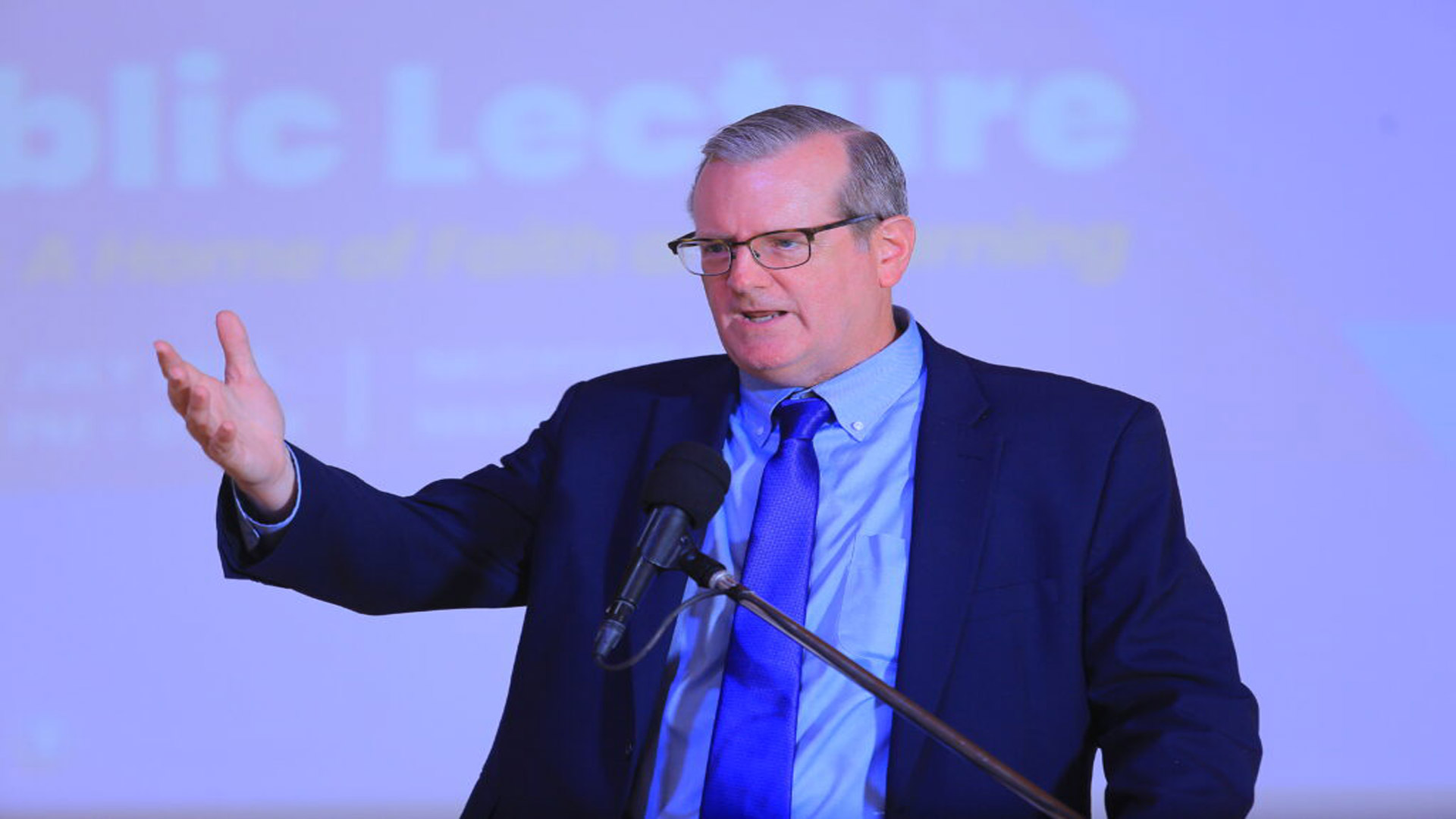
So, why the change of course? And is there anything that can be done about this? These are some of the questions that Dr. Philip Ryken, the President of Wheaton College in Wheaton, Illinois, grappled with during a public lecture he delivered on Faith and Learning at Uganda Christian University (UCU) in 2025.
Upon his arrival, Ryken had a guided tour of UCU, including of the Hamu Mukasa library, where he was impressed to see a large copy of the African Study Bible that to him was a symbol of African Christian scholarship and the pursuit of truth.
“We [UCU and Wheaton] share so much in common, faith in the risen Christ, a commitment to being a Christian institution, not just in name, but in all authenticity and integrity,” Ryken started off his lecture, addressing a fully-packed auditorium of UCU staff, students and special guests.
Giving a historical backdrop to his keynote, Ryken noted that education was highly valued in ancient civilizations like Greece and Rome. It was necessary not only for the advancement of knowledge but also for preparation of leaders for building an empire. On the other hand, Christian leaders of the early Church had a more specific concern — they viewed education as a tool for forming Godly citizens and leaders, he explained.
Several centuries later, Christian leaders like Ryken still hold the same view about the value of education. He argued that the profession and expression of one’s faith ought to go hand-in-hand with one’s academic and professional pursuit. “There should not be any separation between piety and scholarship, between faith and reason, and between faith and science,” said Ryken, an ordained scholar of the Presbyterian Church in America.
“What we need is not Christians who are also scholars [could be any other profession], but Christian scholars.”
Ryken insists that every Christian student or professional should shun compartmentalized spirituality, but rather bring “the fullness of who they are in Christ” to their professional work and identity. He made this note, citing now deceased and former Philosophy Professor at Wheaton College, Arthur F. Holmes, who observed that “we sometimes have a way of separating our spiritual experience from what we want to pursue in entertainment or we think of our life of faith as a thing for Sunday and not our everyday living.”
After his address, an undergrad student in the audience shot up her hand and asked him why universities examine, grade and “rank students” seeing how such a practice fosters an unhealthy competition, envy and jealousy, let alone ‘labelling’ of some students as weak; which are contrary to biblical virtue.
Ryken acknowledged that, indeed, academic rigor comes with frustrations, especially when one must be examined and graded as a marker of progress. But most importantly, he said “it is appropriate to recognize that God has not gifted us equally and we [as college instructors] want to discourage any sense of competition among students and encourage a lot more collaboration.
He called for collaboration through joint projects and coursework, where students work for marks collectively. “A Christ-centred university adds great responsibility on you as an instructor,” Ryken said, urging university administrators to invest in ensuring lecturers fully understand the Christian identity and mission of the university.
The Rt. Rev. Prof. Alfred Olwa, Chairperson of the university Governing Council, commended Ryken for the “insightful” lecture and urged the stakeholders to respond to the calls to action. Olwa said a Christian university “ought to be a home where hearts are formed and minds are informed; a place where the pursuit of truth is harmonized with the pursuit of purpose.”
Olwa, who was representing UCU Chancellor at the public lecture, said: “Students should not just be prepared for jobs, but for life itself, knowing that the knowledge attained is not for pursuing individual ambition, but for serving the common good.
Turning to fellow higher education administrators and scholars, Olwa called for a “reimagination of universities” beyond “just places for lecturers and labs”, but as centres of transformational learning and eternal impact. “Let us cultivate scholarship that uplifts, teaching that transforms and research that redeems.”
UCU Vice Chancellor Prof. Aaron Mushengyezi urged UCU staff to strive to uphold the UCU Christian identity as “UCU ambassadors” wherever they go, noting that many institutions locally and within the region look up to UCU.
The July 2025 public lecture had university heads from outside Uganda, including Vice Chancellor of Kenya-based Daystar University, Prof. Laban P. Ayiro.
Wheaton, UCU and Daystar are members of the Council for Christian Colleges, a global higher education association of more than 170 Christian institutions.